Why the Rated Window Isn’t the Real Window
OITC, U-factor, air leakage - every number is measured on the unit alone. In a wall, the weakest path wins, and it’s almost never the glass.
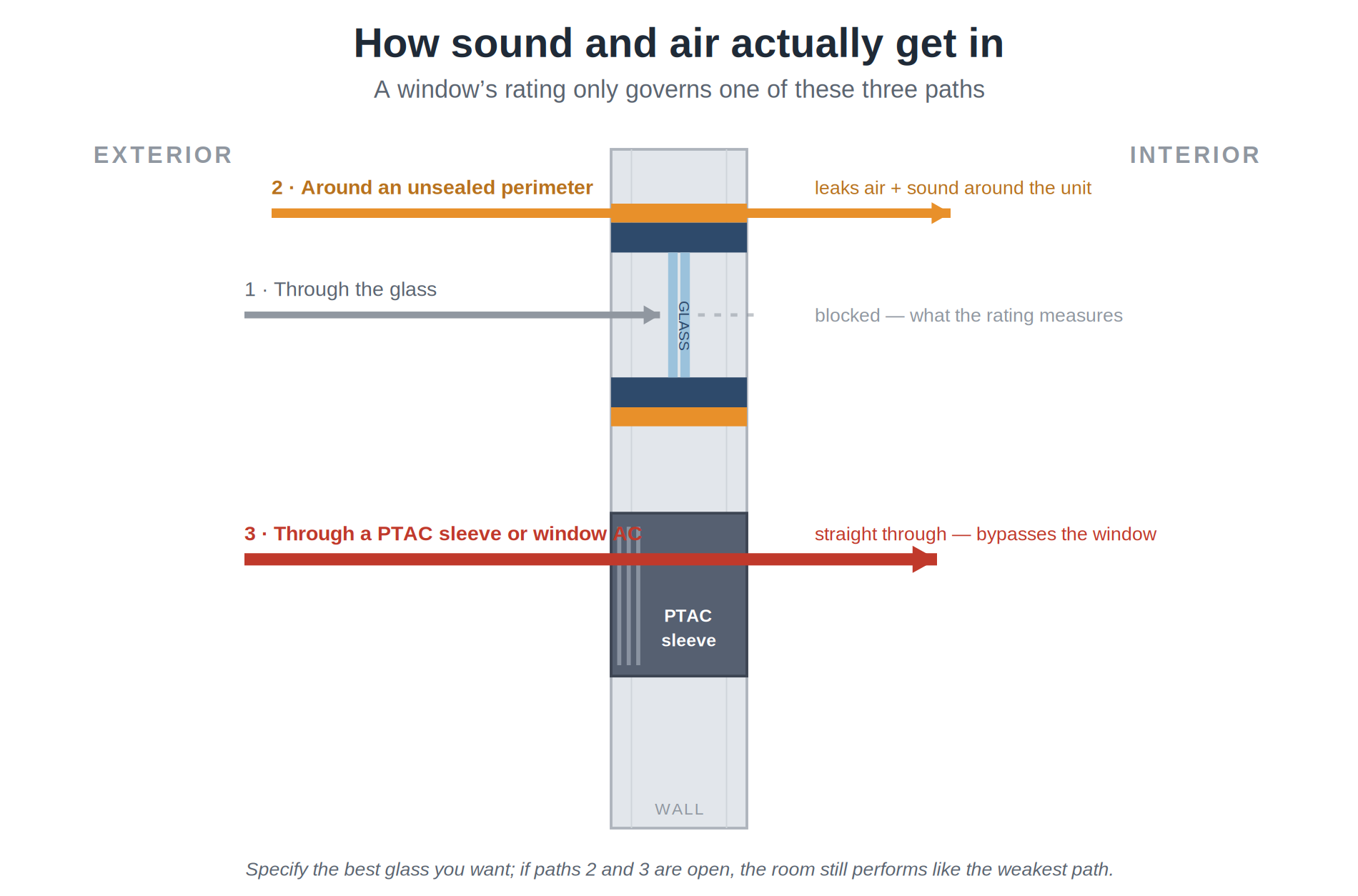
Every number a window carries - its OITC and STC sound ratings, its U-factor, its air-leakage rating - is measured on the unit alone, in a lab, sealed into a test wall. That’s the window’s potential. What a building actually gets is set by the weakest path around the window, and that path is almost never the glass.
The perimeter cavity
Between the window frame and the rough opening there’s a gap, and how that gap gets treated decides more than most people realize. Packed properly - low-expansion foam or mineral wool in the cavity, backer rod and sealant for the air seal - it disappears as a path. Left loose or hollow, it leaks air around a window that may itself be perfectly airtight, and it leaks sound the same way. The acoustic penalty is brutally non-linear: even a small unsealed gap can erase much of an expensive window’s sound rating, because sound, like air, takes the easiest route it can find. A top-tier acoustic window over a sloppily packed perimeter performs like a mid-grade one.
PTAC sleeves and through-wall AC
This is the one clients are most surprised by. A PTAC sleeve is a hole cut through the wall with a thin metal liner and an exterior grille - and acoustically and thermally, that is exactly how it behaves. It bypasses the window and the wall entirely. You can specify the best acoustic glass made, and if there’s a PTAC sleeve beside it, street noise and outside air still pour through the sleeve, around its perimeter, and through the unit’s own louvers. The window cannot fix a problem that isn’t traveling through the window.
Window AC units
The same flanking path, and worse when the unit stays in year-round. The side panels and the gap under the raised sash are thin, uninsulated, and unsealed, so they leak air and sound in every season - and an AC left in through the winter turns a closed window into an open one. Where noise or energy is the priority, the conversation has to include what happens to the cooling, not just the window.
The honest version
You specify the window to the building, but the result you live with is set by the install and by every other penetration in that wall. A window’s rating describes the unit you order. It does not, on its own, describe the room you end up with.
The selection criteria themselves - U-factor and SHGC, certified on the NFRC label, and how the energy code treats replacement versus reglazing - we cover in a separate piece on Local Law 97. The point to carry here is that those numbers describe the unit; the perimeter and the penetrations describe the outcome.
Specify the window to the building. Then seal it like the rating depends on it - because it does. Get both halves right and the window finally performs the way the label promised.
Planning a window project?
Tell us about your building and we’ll come back with the specifics - the right type, frame, and spec for your openings, and a clear path to permit and install.
Request a Free Estimate →